Flex Drill Vs Milwaukee
Power tools have become an essential part of any toolbox, whether you are a professional contractor or a passionate DIYer. Two brands that often compete for the top spot are Flex and Milwaukee. Both offer a wide range of drills designed to make drilling, driving, and fastening tasks smoother and faster. But when you stand in the tool aisle or scroll through online catalogs, the choice between Flex and Milwaukee is not always clear.
Choosing the right drill is more than just picking a popular brand. It’s about finding the best fit for your needs, budget, and long-term goals. Some users want raw power, others want battery life, and many are looking for the best value. In this article, we will break down the differences between Flex drills and Milwaukee drills in detail. You’ll learn about performance, battery technology, design, durability, price, and more. By the end, you will have a clear understanding of which brand suits your requirements best.
Brand Backgrounds
Understanding the history and reputation of each brand can offer insight into their design philosophy and why users trust them.
Flex: Rising Challenger
Flex is a German brand with roots going back to 1922. While Flex has been popular in Europe for decades, it only recently entered the US market with a major push. Known for innovation, Flex focuses on high-performance cordless tools, aiming to compete directly with established American brands. Their partnership with Chervon, a leading power tool manufacturer, has accelerated their growth and development.
Flex’s strategy is aggressive: advanced battery technology, competitive pricing, and strong warranties. They target professionals who want top-tier features without paying extra for a legacy brand.
Milwaukee: Trusted Legend
Milwaukee has been a staple in the power tool industry since 1924. Based in the United States, Milwaukee is famous for its M18 and M12 cordless tool platforms. The brand is recognized for its durability, reliability, and innovation, especially with brushless motors and smart battery systems.
Milwaukee’s tools are found on job sites worldwide. Contractors praise them for their toughness and consistent performance. The company invests heavily in research and development, often leading the market with new technology.
Product Lineup Comparison
Both Flex and Milwaukee offer a range of drills to fit different users. Comparing their lineups helps you see where each brand stands.
Flex Drill Lineup
Flex’s main drill lineup includes:
- Flex 24V Brushless Drill/Driver: The standard option, blending power and compact size.
- Flex 24V Hammer Drill: For users who need to drill into concrete or masonry.
- Flex 24V Impact Driver: Designed for driving screws and bolts with extra torque.
- Flex 24V Right Angle Drill: For tight spaces and awkward angles.
All Flex drills use the 24V platform, meaning one battery fits all tools in the line.
Milwaukee Drill Lineup
Milwaukee’s lineup is broader, with more models for specific needs:
- M18 Fuel Drill/Driver: Flagship brushless model for heavy-duty work.
- M18 Fuel Hammer Drill: Adds hammering action for tough surfaces.
- M12 Drill/Driver: Compact, lighter, and best for light-duty tasks.
- M18 Right Angle Drill: For electricians and plumbers working in tight spots.
- M18 Surge Impact Driver: Uses hydraulic technology for quieter operation.
Milwaukee offers both M18 (18V) and M12 (12V) systems, giving users flexibility.
Performance: Power And Speed
Drill performance is usually measured by torque (twisting force), RPM (rotations per minute), and overall speed. Let’s compare the numbers.
Flex 24v Drill Performance
- Max Torque: Up to 1,400 in-lbs (hammer drill model)
- No-Load Speed: 0-550 / 0-2,000 RPM (2-speed gearbox)
- Blows Per Minute: Up to 34,000 (hammer drill)
Flex drills are designed to deliver high torque, making them suitable for tough materials and large fasteners. The 24V system provides extra power compared to traditional 18V tools.
Milwaukee M18 Fuel Drill Performance
- Max Torque: Up to 1,200 in-lbs (Gen 4 hammer drill)
- No-Load Speed: 0-550 / 0-2,100 RPM (2-speed gearbox)
- Blows Per Minute: Up to 33,000 (hammer drill)
Milwaukee’s flagship drills are known for consistent power. They may have slightly lower torque on paper but make up for it with efficient electronics and motor design.
Side-by-side Power Comparison
| Feature | Flex 24V Hammer Drill | Milwaukee M18 Fuel Hammer Drill |
|---|---|---|
| Max Torque | 1,400 in-lbs | 1,200 in-lbs |
| No-Load Speed | 0-550 / 0-2,000 RPM | 0-550 / 0-2,100 RPM |
| Blows Per Minute | 34,000 | 33,000 |
Insight: Flex drills tend to win on raw torque, while Milwaukee offers a slightly higher top speed. For most users, both brands provide enough power for heavy-duty tasks.
Battery Technology
Cordless drills depend on battery quality. How do Flex and Milwaukee batteries compare?
Flex: 24v Lithium-ion Advantage
Flex uses a 24V lithium-ion system. This provides more cells per battery, increasing energy storage and output.
- Battery Sizes: 2.5Ah, 5.0Ah, 8.0Ah, and 12.0Ah
- Features: Advanced cooling, fast charging, long cycle life
- Backward Compatibility: All 24V Flex tools use the same batteries
The 24V platform gives Flex an edge in power delivery and runtime. The batteries are often larger, but this means more work between charges.
Milwaukee: M18 And M12 Redlithium
Milwaukee relies on the RedLithium battery system in both 18V (M18) and 12V (M12) formats.
- Battery Sizes: 1.5Ah to 12.0Ah (M18), 1.5Ah to 6.0Ah (M12)
- Features: Overload protection, temperature monitoring, long-term durability
- Compatibility: M18 batteries fit all M18 tools; M12 batteries fit all M12 tools
Milwaukee’s batteries are known for reliability. The M18 platform is one of the most popular in the world, with hundreds of compatible tools.
Battery Comparison Table
| Brand | Voltage | Max Ah (Amp Hours) | Charge Time (5Ah battery) | Compatibility |
|---|---|---|---|---|
| Flex | 24V | 12.0 Ah | ~60 minutes | All 24V Flex tools |
| Milwaukee | 18V | 12.0 Ah | ~60 minutes | All M18 tools |
Non-obvious insight: While Flex batteries are 24V, both brands offer similar top capacities. However, Flex batteries are often heavier, which can be tiring during long jobs.
Design And Ergonomics
Comfort and usability can make a big difference, especially for long projects.
Flex Design Features
- Weight: Slightly heavier due to larger batteries
- Grip: Soft, textured rubber for control
- Balance: Good, but top-heavy with large batteries
- LED Light: Bright and focused on the work area
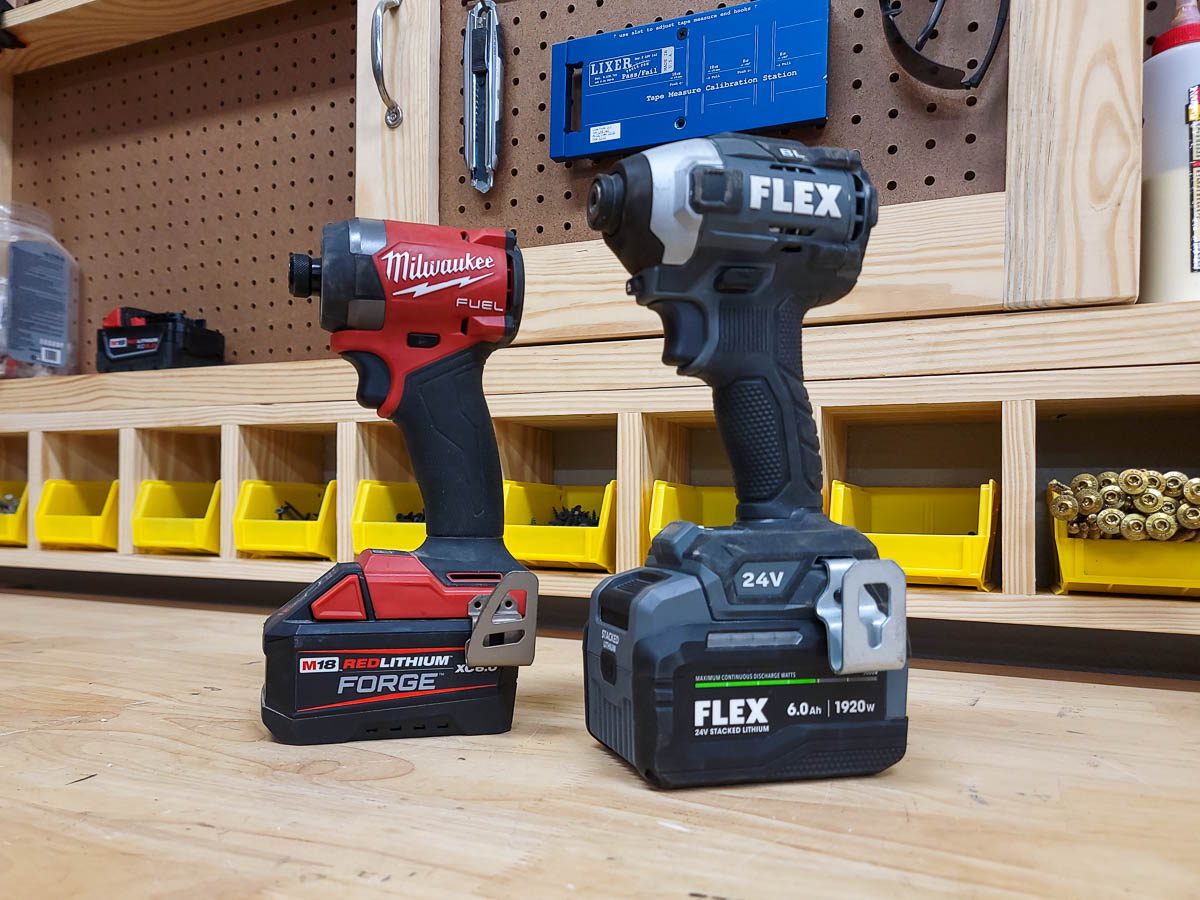
Flex drills are often a bit bulkier. This is the trade-off for higher voltage and larger batteries. Some users with smaller hands may find Flex drills less comfortable for all-day use.
Milwaukee Design Features
- Weight: Lighter and better balanced
- Grip: Ergonomic handle, fits most hand sizes
- Balance: Excellent, even with larger batteries
- LED Light: Consistent across models
Milwaukee’s design is praised for comfort and control. The lighter weight and balanced feel reduce fatigue, especially for overhead work.
Pro Tip: Try holding both brands in-store before buying. Comfort is personal, and even small differences can affect your experience.
Durability And Build Quality
Drills are exposed to drops, dust, and moisture. How do Flex and Milwaukee stand up to abuse?
Flex Durability
Flex drills use reinforced plastic and metal gear housings. They are built for professional use, with strong chucks and impact-resistant bodies. The 24V system has weather-sealed electronics to prevent damage from dust and water.
Milwaukee Durability
Milwaukee is famous for tough tools. Their drills use all-metal gearboxes, shock-absorbing housings, and sealed electronics. Many users report Milwaukee tools lasting 5-10 years, even with daily use.
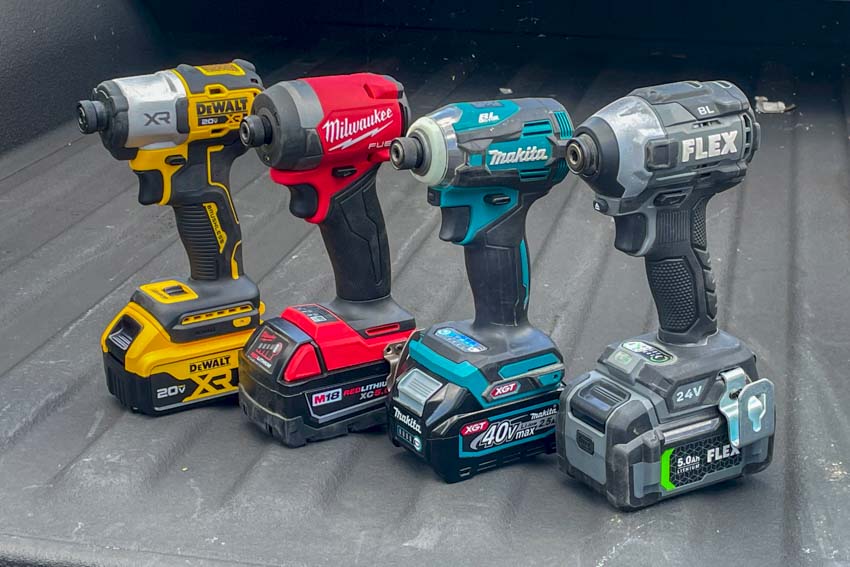
Non-obvious insight: Milwaukee has a longer track record for reliability in extreme conditions. Flex is new to the US market, so long-term durability is not as well documented, but early reviews are positive.
Credit: www.protoolreviews.com
Features And Smart Technology
Modern drills go beyond basic drilling. What smart features do you get?
Flex Features
- Brushless Motor: More efficient, less heat
- Turbo Mode: Boosts power for tough jobs
- Smart Battery Indicator: Shows exact charge left
- Kickback Control: Prevents wrist injuries if bit jams
- Multiple Speed Settings: For better control
Milwaukee Features
- Brushless Motor: Standard in Fuel models
- One-Key Technology: Bluetooth tracking, tool customization, and security
- REDLINK Plus Intelligence: Prevents overload and overheating
- All-Metal Chuck: Holds bits securely
- Variable Speed Trigger: Easy control for delicate work
Milwaukee’s One-Key system is unique. It lets you track your tool, adjust settings via your phone, and lock the tool if stolen. Flex does not have a direct equivalent.
Price And Value
Many buyers focus on cost. Let’s compare the typical prices and what you get for your money.
Flex Pricing
- Drill/Driver Kit (with battery and charger): $179 – $249
- Hammer Drill Kit: $199 – $249
- Bare Tool (no battery): $119 – $159
Flex often includes a long warranty (up to 5 years) and sometimes offers battery bonuses for new buyers.
Milwaukee Pricing
- Drill/Driver Kit (with battery and charger): $199 – $299
- Hammer Drill Kit: $249 – $329
- Bare Tool (no battery): $129 – $179
Milwaukee’s pricing is higher, reflecting the brand’s reputation and long history. Kits usually include a case and sometimes an extra battery.
Value Comparison Table
| Brand | Kit Price Range | Warranty | Extras |
|---|---|---|---|
| Flex | $179 – $249 | 5 years (limited) | Occasional bonus batteries |
| Milwaukee | $199 – $329 | 5 years (limited) | Extra battery in some kits |
Practical tip: If you are starting from scratch, Flex often gives better value for the first purchase. Milwaukee’s higher price pays off if you plan to buy many tools on the same platform.
User Experience And Reviews
What Do Real Users Say About Flex And Milwaukee Drills?
Flex User Feedback
- Power: Users often mention the impressive torque and speed.
- Battery Life: Many report getting through a full day’s work without changing batteries.
- Size/Weight: Some find Flex drills heavy for overhead or long use.
- Availability: Limited in some regions; mostly sold at Lowe’s in the US.
Milwaukee User Feedback
- Reliability: Most users praise Milwaukee for lasting years without failure.
- Comfort: The balance and grip make long jobs easier.
- Features: One-Key and REDLINK systems are popular with pros.
- Price: Some users feel Milwaukee is expensive but worth it for durability.
Example: A contractor switched from Milwaukee to Flex for the torque but returned to Milwaukee for comfort and lighter weight during all-day use.
Pros And Cons
Summing up the key strengths and weaknesses of each brand helps with final decisions.
Flex Pros
- High Torque: Outperforms many competitors in raw power.
- Advanced Batteries: 24V system means longer run times.
- Competitive Pricing: Lower entry cost and frequent bonuses.
- Strong Warranty: Up to 5 years on tools and batteries.
Flex Cons
- Heavier Tools: Can cause fatigue during long use.
- Limited Tool Range: Fewer specialty tools compared to Milwaukee.
- Shorter Track Record: Durability is promising but less proven.
Milwaukee Pros
- Long-Term Reliability: Tools last years, even with heavy use.
- Huge Tool Ecosystem: Hundreds of compatible tools and accessories.
- Smart Features: One-Key, REDLINK Plus, and more.
- Great Ergonomics: Light and well-balanced.
Milwaukee Cons
- Higher Price: More expensive upfront.
- Lower Torque: Slightly behind Flex in some models.
- Older Battery Platform: 18V system not as advanced as 24V, but still strong.
Credit: www.protoolreviews.com
Which Should You Choose?
The answer depends on your needs:
- Choose Flex if you want maximum torque, longer battery life, and the best value on your first purchase. Flex is a great option for those who do tough jobs and don’t mind extra weight.
- Choose Milwaukee if you value long-term reliability, comfort, and a huge selection of compatible tools. Milwaukee is better for professionals who will build out a large tool collection over time.
Non-obvious insight: If you already own tools from one brand, it’s usually best to stay with the same battery platform. Mixing brands means carrying multiple chargers and batteries, which is less efficient.
Frequently Asked Questions
What Is The Main Difference Between Flex And Milwaukee Drills?
The main difference is Flex’s higher 24V battery system, which gives more raw power and longer runtime. Milwaukee relies on an 18V system but offers more comfort, smart features, and a bigger range of compatible tools.
Are Flex Drills As Durable As Milwaukee Drills?
Flex drills are built for professional use, with solid construction and weather-sealed electronics. However, Milwaukee has a longer track record for durability, with many users reporting years of reliable service. Flex is newer, but early reviews are positive.
Can Flex And Milwaukee Batteries Be Used Interchangeably?
No, Flex and Milwaukee batteries are not compatible. Each uses a different voltage and battery design. Always use the correct brand and system for your tools.
Which Brand Offers Better Warranty Coverage?
Both brands offer a 5-year limited warranty on their drills and batteries. Coverage details may vary, so check the fine print before buying.
Where Can I Find More Detailed Specifications For These Drills?
You can visit the official websites of both brands for full specifications and manuals. For more technical details and independent reviews, check Pro Tool Reviews.
Choosing between Flex and Milwaukee drills is not always easy. Both brands offer excellent performance, but your choice should fit your work style, budget, and future tool plans. By understanding the differences, you can invest with confidence and get the most from your new drill.
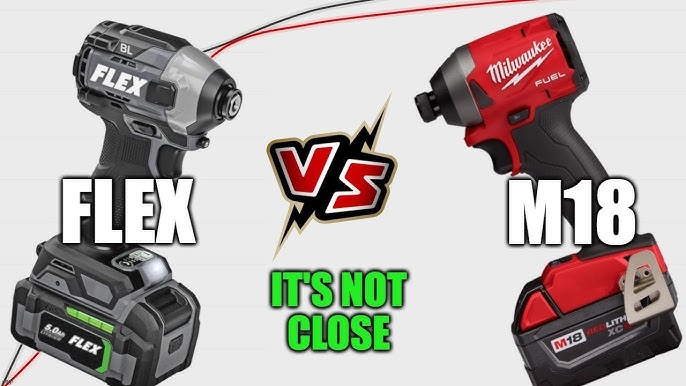
Credit: www.youtube.com