Center Drill Vs Spot Drill: Complete Guide For Precision Machining
Machinists and engineers know that tiny details often make the biggest difference in metalworking. If you want to drill a perfectly centered hole, you cannot just grab any drill bit and hope for the best. Two special tools—center drills and spot drills—play a big role in ensuring accurate hole placement. But what exactly are they? How are they different? When should you use each one? This article will give you a clear, practical understanding of center drills vs spot drills, so you can choose the right tool for every job and avoid common mistakes.
Most beginners think these two tools are the same, but that’s a costly assumption. Using the wrong drill can lead to broken bits, wasted material, and failed projects. With over 2,000 words, this guide will walk you through every detail, including definitions, differences, key applications, common misconceptions, and expert tips for better results.
If you want holes that start true and finish right, keep reading.
What Is A Center Drill?
A center drill is a short, stiff tool with a small pilot point and a thicker body. It is designed to make a small starting hole with a conical seat in the end of a workpiece. The classic use is for preparing metal parts to be mounted between centers on a lathe. The conical seat made by the center drill supports the workpiece during turning.
There are five standard sizes (commonly numbered 1 through 5), each with a specific pilot diameter and included angle, usually 60°. The body is usually made of high-speed steel, but carbide versions are available for harder materials. Center drills are much shorter than standard twist drills, so they resist bending and wandering.
Typical Center Drill Construction
- Pilot tip: A narrow, sharp point for initial contact.
- Body: Thicker, robust, and less prone to deflection.
- Conical seat: Forms a 60° chamfer for lathe centers.
- Shank: Standard sizes fit in drill chucks or collets.
Standard Dimensions
A quick reference for common center drill sizes:
| Size (No.) | Pilot Diameter (mm) | Body Diameter (mm) | Overall Length (mm) | Included Angle (°) |
|---|---|---|---|---|
| 1 | 1.0 | 3.15 | 38 | 60 |
| 2 | 1.5 | 4.75 | 45 | 60 |
| 3 | 2.5 | 6.3 | 56 | 60 |
| 4 | 3.15 | 8.0 | 63 | 60 |
| 5 | 4.0 | 10.0 | 71 | 60 |
Real-world Example
Suppose you are making a shaft that must rotate between centers on a lathe. If you try to start with a twist drill, the bit could walk, creating an off-center hole. By using a center drill first, you create a precise conical seat.
This helps the lathe center support the shaft perfectly, leading to better accuracy and less vibration.
What Is A Spot Drill?
A spot drill is a short, rigid drill bit with a sharp point and a thicker body, designed to create a small dimple or indentation at a precise location. The main job of a spot drill is to guide twist drills and prevent them from wandering or walking when starting a hole. Spot drills do not usually create a conical seat for lathe centers, but instead, they provide an accurate starting point for drilling operations, especially in CNC machining.
Spot drills come in many sizes and tip angles, usually 90°, 120°, or even 142°, depending on the main drill that follows. The diameter can be small or large, but the point is always to start a precise hole, not to make a deep or full-sized one.
Main Features Of Spot Drills
- Short and strong: Resists bending for high accuracy.
- Various point angles: Chosen to match or exceed the following drill’s angle.
- No conical seat: Only a small indentation is made.
- Carbide and HSS versions: Carbide is common for CNC machining due to rigidity.
Example In Practice
If you are drilling a series of holes in a steel plate using a twist drill, you may notice that the drill bit slips on the surface, making crooked holes. A spot drill creates a small, centered dimple for the twist drill to follow.
This improves hole position accuracy and reduces the risk of tool breakage, especially on hard materials or at high spindle speeds.
Center Drill Vs Spot Drill: Key Differences
It’s easy to confuse center drills and spot drills, but their purpose, geometry, and application are quite different. Here’s a breakdown of the main distinctions.
Purpose
- Center Drill: Prepares a workpiece for turning between centers, making a conical seat.
- Spot Drill: Creates an accurate starting point for a twist drill, preventing wandering.
Geometry
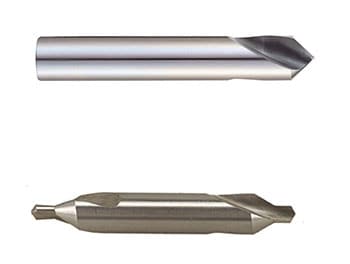
- Center Drill: Has a small pilot tip and a larger body; includes a 60° conical seat.
- Spot Drill: Has a uniform tip angle (often 90°, 120°, or 142°); no pilot.
Application
- Center Drill: Used mainly for lathes and when supporting a workpiece between centers.
- Spot Drill: Used for CNC, manual mills, or drill presses to start holes accurately.
Depth Of Cut
- Center Drill: Makes a shallow hole with a conical seat.
- Spot Drill: Makes a very shallow dimple, just enough for the twist drill to start.
Tool Life
- Center Drill: Prone to breaking if used incorrectly, especially the pilot tip.
- Spot Drill: More robust; less likely to break if used properly.
To help clarify, here’s a side-by-side summary:
| Feature | Center Drill | Spot Drill |
|---|---|---|
| Purpose | Lathe center holes | Accurate hole starting |
| Tip Angle | Usually 60° | 90°, 120°, 142° |
| Pilot Tip | Yes | No |
| Creates Conical Seat | Yes | No |
| Common Use | Lathe turning | Drilling, CNC milling |
When To Use A Center Drill
Choosing the right tool is not just about what you have on hand. The center drill is best used when you need to:
- Prepare for turning between centers: If your workpiece will be mounted between lathe centers, a center drill is essential. The conical seat ensures smooth rotation and reduces the risk of the part coming loose.
- Reduce vibration in long parts: Center drilling both ends of a shaft before turning helps keep the shaft stable, especially for long, thin parts.
- Make a precise starting point for lathe work: The center drill’s pilot tip starts the hole, but it’s the 60° seat that really matters for supporting the work.
Practical Example
Imagine making a precision axle. You need both ends to be perfectly centered, or the axle will wobble. Using a center drill at each end gives you the right seat for the lathe center, guaranteeing better balance.
Common Mistakes With Center Drills
- Drilling too deep: This can weaken the seat and even break the pilot tip.
- Using as a spot drill: Many people try to use a center drill to spot holes, but the pilot tip is weak and can break easily if you go too deep or use it on a hard material.
Credit: www.cnccookbook.com
When To Use A Spot Drill
A spot drill shines in any operation where you want to start a hole accurately, especially in CNC machining or when using a drill press. Some specific situations include:
- Drilling multiple holes in a pattern: If you need many holes in precise locations, a spot drill ensures each one starts where you want.
- Working with hard or slippery materials: Spot drills prevent twist drills from skating off, leading to crooked holes.
- High-speed CNC operations: Spot drills are rigid and handle rapid operations without flexing or chipping.
Real-world Application
Suppose you’re making a mounting plate with 20 holes for bolts. If you skip the spot drill, some holes may be off-center, causing assembly problems. With a spot drill, every hole starts true, and the finished part fits perfectly.
Common Mistakes With Spot Drills
- Using the wrong tip angle: The spot drill tip angle should be equal to or greater than the following twist drill’s angle. If it’s less, the twist drill can skip or cut unevenly.
- Confusing with center drill: Spot drills do not make a conical seat, so never use them to prepare for turning between centers.
How To Choose: Center Drill Vs Spot Drill
Choosing between a center drill and a spot drill comes down to your project goals:
- For lathe work (between centers): Always use a center drill.
- For precise hole locations (drilling): Use a spot drill.
But there’s more to consider. Here are two insights beginners miss:
- Twist drill point angle matters: If your spot drill has a 90° tip but your twist drill is 118°, the twist drill may not seat perfectly. Always use a spot drill with a tip angle equal to or greater than the twist drill.
- Tool wear and breakage: Center drills have a delicate pilot tip. If you use a center drill as a spot drill on a hard or thick plate, the tip can snap off. Spot drills are stronger and better for most spotting tasks.
Tool Geometry And Its Importance
Tool geometry is not just a technical detail—it directly affects your results.
Center Drill Geometry
- Pilot tip: Small, often 1-2 mm, and fragile.
- Body: Larger diameter, provides stiffness.
- Conical seat: Makes a 60° chamfer.
The pilot tip is critical for location but very easy to break if misused. Always drill slowly and do not go deeper than needed.
Spot Drill Geometry
- Tip angle: 90°, 120°, or 142°—designed to match or exceed the twist drill.
- Short, thick body: Reduces deflection and increases accuracy.
- No pilot: The entire tip cuts at once.
For CNC and manual work, the right spot drill geometry means straighter, more accurate holes and less tool breakage.
Geometric Mismatch: A Hidden Problem
Many beginners use a 90° spot drill for everything. But if your twist drill has a 118° or 135° tip, the twist drill will not fully contact the bottom of the spotted hole. This can cause the twist drill to shift when starting, making the hole wander.
For best results, select a spot drill with a tip angle at least as large as your twist drill.
Examples Of Common Applications
Let’s look at real-world situations where choosing the right tool can make or break a project.
Scenario 1: Turning A Shaft On A Lathe
- Tool: Center drill
- Why: The conical seat is needed for the lathe center.
- Result: Shaft rotates smoothly, less vibration, better finish.
Scenario 2: Drilling A Bolt Pattern On A Plate
- Tool: Spot drill
- Why: Ensures each hole starts at the exact marked position.
- Result: All bolts line up, assembly goes smoothly.
Scenario 3: Machining Small Parts In A Cnc Mill
- Tool: Spot drill
- Why: High spindle speeds and rapid tool changes need a robust, short starter.
- Result: Minimal tool deflection, consistent hole positioning.
Scenario 4: Making A Center Hole In Hard Steel
- Tool: Carbide center drill (if required for hardness)
- Why: Standard HSS may dull or break; carbide handles tough materials.
Scenario 5: Deep Hole Drilling In Thin Material
- Tool: Spot drill, then twist drill
- Why: The spot prevents the twist drill from walking on thin, flexible material.

Credit: www.reddit.com
Cost, Availability, And Practical Considerations
Cost Differences
- Center drills are usually inexpensive, especially in standard HSS.
- Spot drills can be pricier, especially in solid carbide or special angles.
For most shops, both are affordable, but using the wrong tool can cost more in broken bits and ruined parts.
Tool Life
Spot drills generally last longer in spotting applications because they are stronger. Center drills, especially their pilot tips, wear quickly if used for spotting or in hard materials.
Availability
Both tools are widely available from industrial suppliers. Spot drills come in more tip angles and diameters, while center drills are standardized.
How To Use Center Drills And Spot Drills (step-by-step)
Using A Center Drill
- Mark the hole center: Use a center punch or layout tools.
- Secure the workpiece: Clamp firmly to avoid movement.
- Set spindle speed: Use a lower RPM for larger center drills.
- Align the drill: Bring the center drill into contact with the marked spot.
- Drill gently: Feed slowly until the conical seat forms. Do not go too deep.
- Withdraw the tool: Clean the hole before turning.
Using A Spot Drill
- Layout the hole location: Mark with a punch if needed.
- Clamp the workpiece: Prevents shifting under pressure.
- Select the right tip angle: Match or exceed the twist drill’s angle.
- Set spindle speed: Spot drills can handle higher RPM, especially in CNC.
- Feed to shallow depth: Just enough to create a dimple.
- Remove the tool: Continue with the twist drill.
Advanced Tips For Better Results
- Keep tools sharp: Dull center or spot drills can slip and ruin accuracy.
- Use cutting fluid: Improves finish and tool life, especially in tough metals.
- Check runout: A bent drill chuck or collet can cause holes to wander, even with perfect spotting.
- Replace worn tools: Center drill pilot tips chip easily; spot drills lose sharpness at the point.
- For CNC, use carbide spot drills: They withstand higher forces and last longer.
Case Study: Cnc Shop Reduces Scrap Rate
A medium-sized CNC shop was having problems with off-center holes in aluminum plates. They were using center drills to spot holes before twist drilling, leading to many broken tips and inaccurate holes. After switching to proper spot drills with a 120° angle (to match their 118° twist drills), the scrap rate dropped by 40%, tool life increased, and job times shortened.
This simple change saved thousands of dollars per year.
Myths And Misconceptions
Many machinists believe center drills can always be used as spot drills. This is not true. The pilot tip on a center drill is weak and designed for very shallow, precise holes. Spot drills are engineered for robustness and accuracy in starting holes for drilling.
Another misconception is that the tip angle does not matter. In reality, using the wrong angle can cause the twist drill to walk or cut unevenly, especially in CNC work.
Expert Recommendations
- Use the right tool for the job: Center drills for lathe centers, spot drills for accurate hole starting.
- Match angles: Always check the tip angle of your spot drill against the twist drill.
- Don’t over-drill: Only drill as deep as needed for the seat or dimple.
- Inspect often: Center drill pilots and spot drill tips wear fast—replace as needed.
- Choose carbide for hard or high-speed work: Carbide spot drills and center drills last longer in demanding conditions.
For more in-depth technical details and standards, the Wikipedia page on drill bits is a reliable resource.
Frequently Asked Questions
What Is The Main Difference Between A Center Drill And A Spot Drill?
A center drill is used to make a conical seat for turning between centers on a lathe, while a spot drill is used to create an accurate starting point for drilling holes. Center drills have a pilot tip and a 60° seat; spot drills have a single tip angle and do not make a seat.
Can I Use A Center Drill As A Spot Drill?
It is not recommended. Center drill pilot tips are fragile and break easily if used to spot holes, especially in hard materials or for deep spotting. Spot drills are designed to handle the forces of starting holes and are stronger.
Why Does Tip Angle Matter For Spot Drills?
The tip angle should match or be slightly greater than the following twist drill’s angle. If it is less, the twist drill can wander or cut unevenly, leading to inaccurate holes. Common twist drill angles are 118° and 135°, so choose a spot drill with at least that angle.
Are Spot Drills Necessary For Manual Drilling?
Spot drills are not always required for manual drilling, but they greatly improve accuracy, especially for closely spaced holes, hard materials, or if you want a professional finish. For most precise work, using a spot drill is a good practice.
Which Tool Should I Use For Cnc Machining?
For CNC machining, always use a spot drill to start holes. Center drills are not designed for this and may break quickly. Choose a carbide spot drill with the correct tip angle for best results.
Final Thoughts
Choosing between a center drill and a spot drill is not just a technical detail—it is essential for success in precision machining. Each tool has a unique purpose, geometry, and best use case. By understanding the differences and following best practices, you can avoid common mistakes, improve accuracy, and save both time and money.
Whether you work on a manual lathe or a modern CNC mill, the right starter drill can make all the difference between a part that fits perfectly and one that ends up in the scrap bin.
Next time you set up a job, pause and ask: “Do I need a conical seat for a lathe center, or do I just need a precise hole start?” With this knowledge, you’ll make the right choice—and your projects will show it.

Credit: www.youtube.com