Milwaukee M18 Fuel Hammer Drill Vs Dewalt: Detailed Comparison of 18 Key Aspects
Choosing the right hammer drill can make a big difference on the job site. For many professionals and DIY enthusiasts, the decision often comes down to two giants: the Milwaukee M18 Fuel Hammer Drill and the DeWalt Hammer Drill. Both brands are known for their power tools, but which one is the better choice for your needs? This article gives you a deep, head-to-head comparison across 18 important factors. Whether you are new to tools or an experienced tradesperson, this guide will help you understand the details that really matter.
1. Brand Reputation
Milwaukee and DeWalt are two of the most respected names in power tools. Milwaukee, established in 1924, is praised for its focus on heavy-duty tools and innovation, especially in cordless technology. The M18 Fuel series is one of their flagship lines, known for reliability and performance.
DeWalt, founded in 1923, has long been a favorite in construction and woodworking. It is famous for durability and wide service networks. While both brands have loyal users, Milwaukee is often seen as more innovative in batteries and motors, while DeWalt gets high marks for tool longevity and easy service.
Beginners sometimes overlook the value of after-sales support; DeWalt’s service centers are more widespread, which can be a time-saver if something goes wrong.
2. Motor Technology
The Milwaukee M18 Fuel Hammer Drill uses a POWERSTATE brushless motor. This design increases efficiency and extends the tool’s life. Milwaukee’s motor is built in-house, which ensures tight quality control.
DeWalt’s latest hammer drills also use brushless motors. Their motors are well-made, but many experts consider Milwaukee’s brushless motors to be slightly more advanced, especially regarding heat management and sustained torque. This means Milwaukee can often work harder for longer periods without overheating—a detail that matters on tough jobs.
3. Battery System
Milwaukee’s M18 battery system is one of the most flexible in the industry. All M18 batteries fit every M18 tool, including the Fuel hammer drill. The REDLITHIUM batteries are known for holding charge well and performing in cold weather.
DeWalt uses the 20V MAX battery system. It’s also versatile and widely used, but DeWalt’s batteries tend to have less cold-weather performance compared to Milwaukee’s. Both brands offer high-capacity (5Ah and up) batteries, but Milwaukee’s “High Output” series is often favored for longer runtime.
Many users overlook battery compatibility. If you already own tools from one brand, it’s usually best to stick with that brand’s battery system to avoid extra costs and confusion.
4. Power And Torque
The M18 Fuel Hammer Drill delivers up to 1,200 in-lbs of max torque (in recent models). This high torque allows the drill to handle tough materials like concrete and thick metal with ease.
DeWalt’s top hammer drills provide about 1,090 in-lbs of max torque. While the difference is not huge, Milwaukee’s torque advantage is noticeable in demanding tasks. For example, when drilling large holes in masonry, Milwaukee tends to power through faster.
A common mistake is choosing a drill based on voltage alone. Torque is more important for real work, and here Milwaukee has a slight edge.
5. Drilling Speed (rpm)
Milwaukee’s M18 Fuel models can reach up to 2,000 RPM in high-speed mode. This speed is great for fast drilling in wood or metal. The tool usually features two speed settings for flexibility.
DeWalt’s comparable hammer drills also reach around 2,000 RPM. In real-world use, both drills deliver fast drilling, but Milwaukee’s electronic controls keep the speed more consistent under heavy load. This can mean cleaner holes and fewer stalls.
6. Hammering Action (bpm)
For hammer drilling, blows per minute (BPM) matter. The Milwaukee M18 Fuel can deliver up to 32,000 BPM. This high BPM makes it effective for drilling into concrete and masonry.
DeWalt’s top hammer drills offer about 34,000 BPM. So in pure hammering action, DeWalt actually has a slight edge. If your main work is drilling into brick or concrete, the higher BPM may give DeWalt a small advantage.
However, beginners sometimes forget that torque and BPM together matter. Milwaukee’s higher torque plus nearly the same BPM means it rarely falls behind, even in tough jobs.

Credit: toolguyd.com
7. Chuck Quality And Size
Both brands use 1/2-inch metal ratcheting chucks on their premium hammer drills. Milwaukee’s chuck is praised for its tight grip and durability, reducing bit slippage.
DeWalt’s chuck is also solid and easy to use, with a strong locking mechanism. Some users prefer Milwaukee’s chuck for its smoother operation, but both are reliable. Neither brand uses plastic chucks in their high-end models—a detail that matters for heavy use.
8. Build Quality And Materials
Milwaukee’s M18 Fuel hammer drill is made with high-strength composites and metal gear cases. The tool feels robust and well-balanced in hand. The rubber over-mold on the grip helps reduce vibration and increases comfort.
DeWalt’s construction is similar, with reinforced housings and all-metal gears. DeWalt is famous for surviving drops and tough sites. In side-by-side tests, both tools can take a beating, but Milwaukee sometimes feels a bit heavier and more solid.
One detail beginners miss: the weight difference is small, but Milwaukee’s extra weight can reduce vibration, while DeWalt’s lighter build may be easier for overhead work.
9. Weight And Ergonomics
The Milwaukee M18 Fuel Hammer Drill weighs about 4.5 lbs (tool only, without battery). With a 5Ah battery, the total weight is around 6 lbs. The grip is ergonomic, and the balance is good, especially with Milwaukee’s compact batteries.
DeWalt’s comparable models weigh about 4.0 lbs bare, and just over 5.5 lbs with a battery. DeWalt’s handle design is slightly slimmer, which some users with smaller hands prefer.
A common mistake: buying the most powerful drill and forgetting about weight. If you drill for hours at a time, every ounce counts. Try holding both in the store before buying.
10. Size And Compactness
Milwaukee’s M18 Fuel Hammer Drill is about 6.9 inches long (front to back). This compact size helps when drilling in tight spaces or inside cabinets.
DeWalt’s top hammer drills are slightly longer, around 7.5 inches. The extra length is not usually a problem, but if you do lots of work in cramped areas (like electrical boxes), Milwaukee’s shorter body is an advantage.
11. Clutch Settings And Control
Milwaukee provides 14–16 clutch settings on the M18 Fuel, plus a drill and hammer mode. The clutch controls are precise and easy to adjust, letting you set the exact torque for screws or bolts.
DeWalt also offers around 13–15 clutch settings. Both brands have smooth selectors, but Milwaukee’s clutch ring is sometimes a bit tighter, which can help prevent accidental changes.
Beginners often ignore clutch settings, but correct use can prevent stripped screws and broken bits. Both brands make it easy to switch between drilling, driving, and hammer modes.
12. Led Work Light
Both Milwaukee and DeWalt include built-in LED lights near the chuck. Milwaukee’s LED is bright and well-positioned, illuminating the work area clearly. On some models, the light stays on for several seconds after releasing the trigger.
DeWalt’s LED is similar, but the newest models feature a three-mode LED with a spotlight function. This can be handy in dark corners or basements.
A detail often missed: DeWalt’s “20-minute shutoff” spotlight is unique and useful for long tasks in low light.
13. Noise And Vibration
Milwaukee’s brushless motor and over-mold grip help keep vibration and noise low. While no hammer drill is quiet, Milwaukee’s design is less fatiguing after long use.
DeWalt’s drills are also well-damped, but some users find them a little louder and with slightly more vibration, especially in hammer mode. If you are sensitive to noise, Milwaukee is generally the better choice.
14. Kit Options And Accessories
Milwaukee offers the M18 Fuel Hammer Drill as a bare tool or as a kit with batteries, charger, and case. Their accessory kits often include high-quality drill and driver bits.
DeWalt also sells both bare tools and kits. DeWalt kits sometimes include extra features like a side handle or contractor bag.
A tip for beginners: consider the total value. Sometimes the Milwaukee kit has better batteries, while DeWalt includes more bits or extras. Check the kit contents carefully before buying.
15. Price And Value
Milwaukee M18 Fuel Hammer Drills are often $180–$220 for the bare tool, with kits around $300–$350. Prices vary by battery size and included accessories.
DeWalt’s top hammer drills are usually a bit less expensive: $150–$200 for the bare tool, and $250–$320 for kits.
While Milwaukee is pricier, its performance and durability often justify the cost for heavy users. However, for homeowners or light-duty use, DeWalt’s lower price might offer better value.
A common mistake is focusing only on the tool price. Consider battery prices, warranty, and included accessories for the real cost.
16. Warranty And Service
Milwaukee offers a 5-year limited warranty on the M18 Fuel Hammer Drill. This covers defects in material and workmanship, but not normal wear or abuse.
DeWalt provides a 3-year limited warranty, plus a 1-year free service contract and a 90-day money-back guarantee.
Milwaukee’s longer warranty is a clear benefit for professionals. However, DeWalt’s service network is larger, which means faster repairs in most locations.

Credit: www.youtube.com
17. Real-world Performance
In hands-on tests, both drills perform well for most tasks. Milwaukee’s higher torque shines in tough jobs like mixing mortar or drilling large holes in concrete. It rarely overheats and delivers consistent power.
DeWalt’s hammer drill is quick, reliable, and easy to handle. It works well for wood, metal, and masonry, though it may slow down a bit on the toughest jobs.
A non-obvious insight: Milwaukee’s REDLINK PLUS electronics protect against overload and overheating, which helps the tool last longer. DeWalt’s electronic controls are good, but not as advanced.
18. Availability And Global Support
Milwaukee tools are widely available in North America, Europe, and Australia. Their distribution is strong, but less so in some parts of Asia and Africa.
DeWalt has a truly global presence, with parts and service centers in more countries. This can be important if you work internationally or need replacement parts quickly.
Some users overlook the importance of local support. Having easy access to service is a big advantage, especially for professionals who can’t afford downtime.
Side-by-side Comparison
Here’s a summary of the key specifications for both drills:
| Feature | Milwaukee M18 Fuel | DeWalt Hammer Drill |
|---|---|---|
| Max Torque | 1,200 in-lbs | 1,090 in-lbs |
| Max RPM | 2,000 | 2,000 |
| Max BPM | 32,000 | 34,000 |
| Weight (Bare) | 4.5 lbs | 4.0 lbs |
| Warranty | 5 years | 3 years |
User Experience And Feedback
Many professionals say the Milwaukee M18 Fuel Hammer Drill feels more powerful, especially under heavy load. It’s a favorite for electricians, plumbers, and remodelers who need reliable, all-day performance.
DIY users often pick DeWalt for its good balance of power, comfort, and price. DeWalt’s lighter weight is a plus for overhead work or long projects.
A unique insight: users who switch from DeWalt to Milwaukee usually notice the longer runtime and more stable speed under pressure. But those who move from Milwaukee to DeWalt often mention how comfortable and easy to handle DeWalt’s drills are.
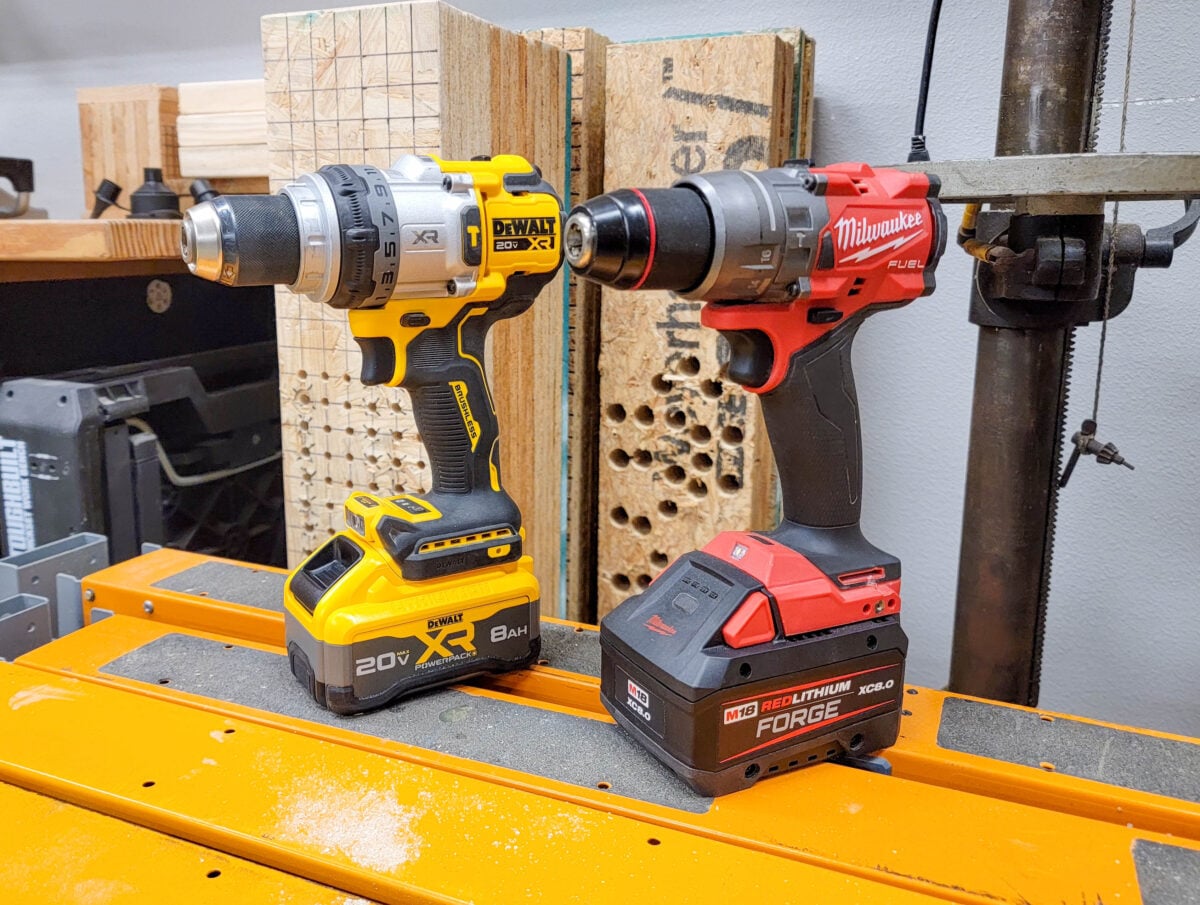
Credit: www.protoolreviews.com
Battery Performance In Real Conditions
Cold weather is a challenge for cordless tools. Milwaukee’s REDLITHIUM batteries are famous for working in temperatures as low as 0°F (-18°C). DeWalt’s batteries perform well but may lose capacity faster in freezing conditions.
Another detail: Milwaukee’s battery fuel gauge is more accurate, letting users know exactly when to recharge. DeWalt’s gauge is simpler, showing only three bars.
Here’s a quick look at battery system differences:
| Aspect | Milwaukee M18 Fuel | DeWalt Hammer Drill |
|---|---|---|
| Battery Type | 18V REDLITHIUM | 20V MAX Lithium-Ion |
| Runtime (5Ah) | Up to 1.5 hours | Up to 1.2 hours |
| Cold Weather | Excellent | Good |
| Fuel Gauge | 4-bar, accurate | 3-bar, basic |
Safety Features
Milwaukee’s M18 Fuel Hammer Drill includes REDLINK PLUS electronic protection. It automatically stops the tool if it gets too hot or overloaded, which prevents damage.
DeWalt has electronic controls too, but they are less advanced. Both brands include a side handle for safer two-handed use, especially in hammer mode. Always use the side handle when drilling into masonry or using large bits.
Long-term Durability
Independent tests show that Milwaukee’s M18 Fuel Hammer Drill can last over 1,000 cycles of heavy use without major problems. The all-metal gear case and brushless motor contribute to its long life.
DeWalt’s drills are also very durable, with many users reporting years of trouble-free use. However, some users report that DeWalt’s clutches wear out faster under constant heavy load.
A detail beginners miss: regular maintenance, like cleaning the chuck and checking for debris, will extend the life of both tools.
Which Is Right For You?
If you need maximum power, runtime, and durability for professional work, the Milwaukee M18 Fuel Hammer Drill is hard to beat. Its higher price is justified by advanced electronics, better cold-weather battery performance, and longer warranty.
If you want a drill that is lighter, comfortable, reliable, and a bit less expensive, the DeWalt Hammer Drill is a smart choice. It’s perfect for most home improvement and light professional jobs.
For most users, you won’t go wrong with either. The best choice often depends on which battery system you already own, your budget, and how often you use the tool.
For more technical details, you can visit the official DeWalt site.
Frequently Asked Questions
What Is The Main Difference Between Milwaukee M18 Fuel And Dewalt Hammer Drill?
The biggest differences are in torque, electronics, and battery performance. Milwaukee offers higher torque and more advanced electronic protection, while DeWalt is slightly lighter and often less expensive.
Are Milwaukee M18 And Dewalt 20v Batteries Interchangeable?
No, Milwaukee M18 and DeWalt 20V MAX batteries are not interchangeable. Each brand uses a unique battery design, so you must use the correct battery for your tool.
Which Drill Is Better For Concrete And Masonry?
Both drills perform well, but DeWalt’s higher BPM gives it a slight edge in pure hammer action. However, Milwaukee’s higher torque makes it better for larger holes or tougher materials.
Does The Milwaukee M18 Fuel Hammer Drill Come With A Case And Accessories?
It depends on the kit you buy. Some packages include a hard case, batteries, charger, and side handle, while others are sold as bare tools. Always check the product listing before buying.
How Long Do The Batteries Last During Real Work?
With a 5Ah battery, Milwaukee’s M18 Fuel can run about 1.5 hours of moderate use per charge. DeWalt’s 5Ah battery lasts about 1.2 hours. Runtime depends on the type of work and how hard you push the tool.
—
Choosing between the Milwaukee M18 Fuel Hammer Drill and DeWalt Hammer Drill comes down to your needs and preferences. Both are top performers with unique strengths. By understanding these 18 key factors, you can confidently pick the tool that fits your projects best.